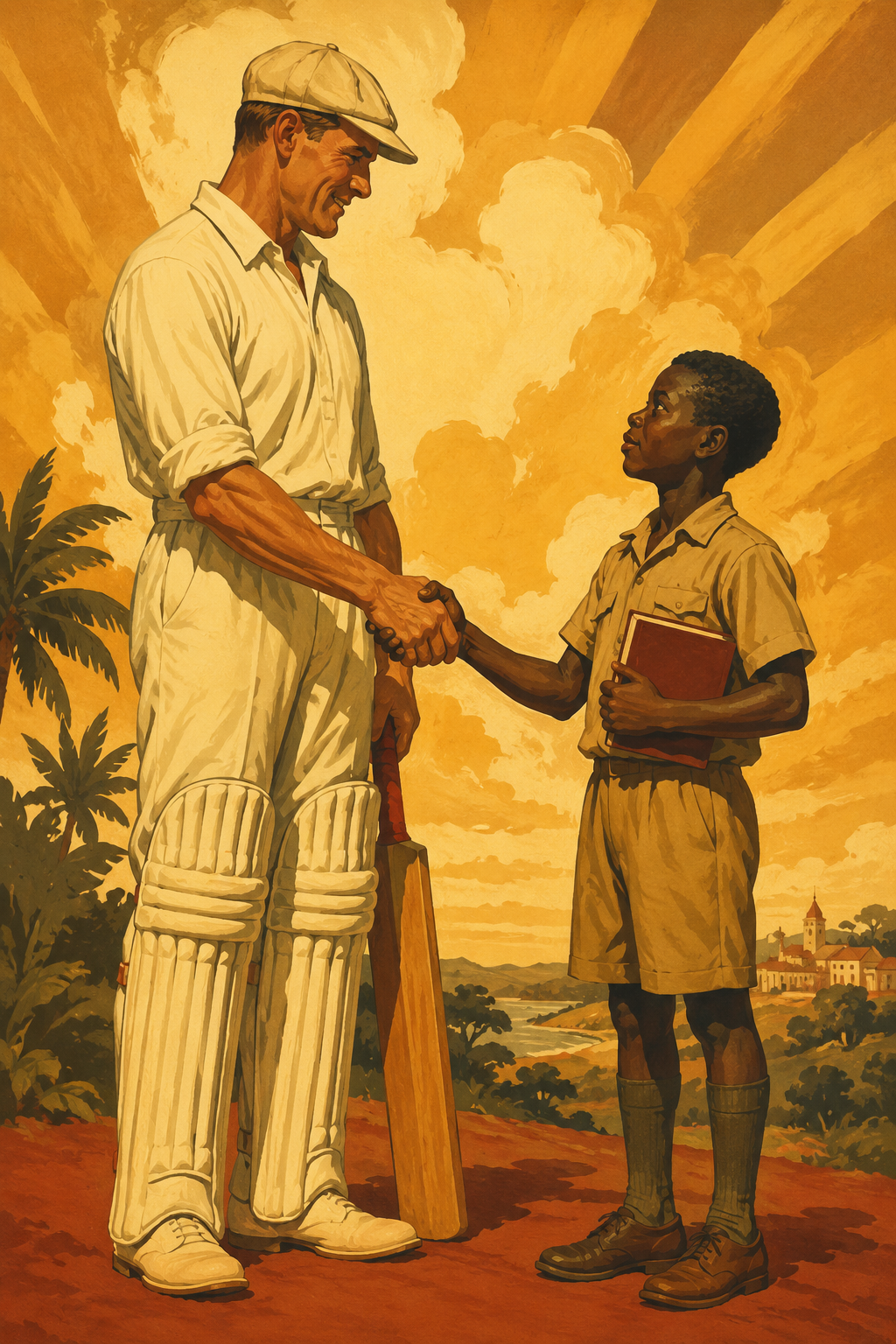
Cricket For Change: sport and education meeting across continents
Understanding the Crisis
Geography and Poverty
Togo is a small, narrow country in West Africa, stretching from the Gulf of Guinea in the south to Burkina Faso in the north. While the capital Lomé has modern infrastructure and a growing economy, rural Togo — particularly the central and northern regions — remains profoundly poor. For families scraping a living from subsistence farming, the cost of school fees, uniforms, and books is simply out of reach.
The Literacy Emergency
When 82% of ten-year-olds cannot read fluently, the consequences compound rapidly. Children who fall behind in literacy in early primary school rarely catch up. Without reading, mathematics becomes harder to access. Without literacy and numeracy, the secondary school curriculum is closed off. And without secondary education, formal employment is largely unavailable.
"The children want to learn. The teachers want to teach. What is missing is the resource to make it happen consistently, year after year."
Girls and Education
The enrolment gap between boys and girls — 10% at every level of the school system — reflects a set of deeply embedded cultural assumptions about the value of girls' education. Families facing a choice about which children to educate in a resource-constrained environment often make decisions shaped by tradition rather than potential. Togo Union UK works specifically to support girls' continued access to schooling, knowing that educated women are the single most effective lever for intergenerational change.
What £55 a Month Actually Buys
It is remarkable how far a modest monthly donation stretches in rural Togo. For £55 a month, Togo Union UK covers:
- School registration and term fees
- Textbooks and exercise books for every subject
- A school uniform (a requirement at most schools)
- Basic stationery — pens, pencils, rulers, a schoolbag
- Where needed, a contribution to transport to school
In other words: everything. One child. One year. Fully covered. For the price of a monthly coffee subscription.
About Togo Union UK
Founded by the Community, for the Community
Togo Union UK was established in 1982 by Togolese people living in the United Kingdom — a community coming together to maintain ties with their homeland and support each other in a new country. For its first decades, the organisation focused on cultural identity, welfare, and diaspora community building.
Becoming a Registered Charity
In 2008, Togo Union UK registered as a charity (No. 11135050) and began to formalise its charitable work. From 2010, the focus shifted decisively toward education: direct funding of school places for children in rural Togo who would otherwise have no access to schooling.
How the Money Gets There
Because Togo Union UK is run by people with deep roots in Togo — family connections, longstanding relationships with communities and schools — the charity operates with minimal overhead and maximum local knowledge. Donations are directed to named schools and individual children, with regular reporting back to the committee on outcomes.
The Committee
Togo Union UK is led by a small, committed volunteer committee:
- Mrs Veronica Lassey — Chair
- Mr Isidore Dossouhon — General Secretary & Treasurer
- Mrs Mansa Dejean — Welfare Officer
These are not career charity professionals. They are members of the community — people with day jobs, families, and full lives — who give their spare time to something they believe in deeply.